

.svg)

Google Gemini eDiscovery: How to Collect AI-Generated Content
Google bundled Gemini into every Business and Enterprise Workspace plan, and most legal teams did not get a heads-up. Every licensed employee can now draft emails, summarize documents, and run AI-assisted meetings without an admin flipping a switch. The result is a new category of discoverable content sitting inside Gmail, Docs, Drive, Meet, and Chat, generated by tools that most litigation hold notices were never written to cover.
Google Gemini collections refers to the process of identifying, preserving, and exporting AI-generated content, including prompts, responses, and referenced files, created within Google Gemini and Google Workspace, so this content can be reviewed and produced in litigation and investigations. Because Gemini is embedded across Workspace rather than run as a separate application, a Google Gemini collection typically pulls from several places at once: the Gemini conversation itself, referenced Drive files, and the outputs Gemini generates on a user's behalf.
AI-Generated Content Is Already Discoverable, and Courts Have Said So
Legal teams that assume prompts and outputs sit outside the scope of a hold are already behind. In In re OpenAI, Inc., Copyright Infringement Litigation, a federal magistrate judge compelled production of millions of generative AI logs, including user prompts and model responses, finding the records relevant and proportional to the claims at issue, provided user references were anonymized. In a related ruling in the same litigation, a request to produce content from an organization's internal AI tools was denied as disproportionate, underscoring that relevance and proportionality, not the fact that a machine generated the content, are what determine discoverability. The same period of litigation also saw the Delaware Court of Chancery, in Fortis Advisors v. Krafton, compel production of ChatGPT interactions as evidence in a contract dispute. Google's own terms reinforce why this matters for Gemini specifically: enterprise Workspace and Vertex AI tiers are not used to train public models, but conversation history, outputs, and referenced files still exist somewhere and are still subject to a hold once litigation is reasonably anticipated.
Why Gemini Is a Different Kind of Data Source
Traditional eDiscovery assumes a human created the content under review. With Gemini, half of every conversation is machine-generated, and that changes how the data needs to be preserved and understood.
A Single Interaction Spans Multiple Services
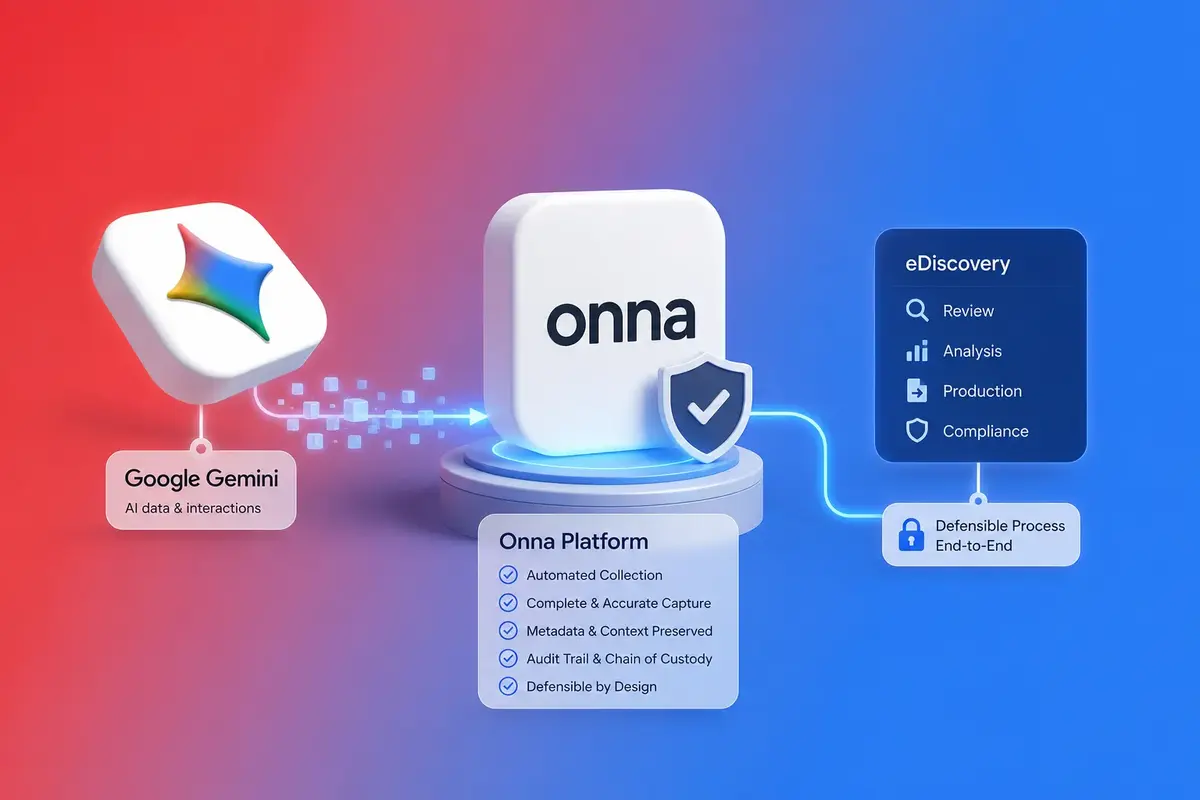
A single Gemini interaction can include a user prompt, an AI response, a referenced Drive file, and a generated output, each governed by different retention rules. Documents Gemini creates land in Google Drive under Drive retention policy, not Gemini policy, so misaligned rules can leave a legal team with only half the record when a matter opens. Onna's Google Gemini connector addresses this by capturing structured AI interaction data, including prompts, responses, timestamps, and model metadata, through the Google Vault eDiscovery API, so investigators can reconstruct the full AI-assisted workflow rather than a fragment of it.
Vault Coverage Varies by Workspace Tier
Google Vault covers the Gemini app and embedded Workspace features, but it does not cover the Gemini API or Vertex AI, which require their own logging strategy entirely. Business Starter and Standard plans have no native Vault coverage for Gemini at all: no retention rules, no legal holds, and no defensible export path without an upgrade. Onna's practical guide to eDiscovery for Google Gemini walks through this tier-by-tier coverage gap, along with the 30-day purge buffer that legal teams should not rely on as a substitute for a proper hold.
What a Defensible Google Gemini Collection Requires
A defensible collection needs to preserve conversational structure end-to-end, not just the final output, because context is what makes an AI-generated document explainable later. That means capturing prompts, responses, conversation threads, timestamps, and model metadata as structured records, with human and AI contributions clearly distinguishable from one another.
This is the gap Onna built its Gemini capabilities to close. As outlined in Onna's expanded collection capabilities for legal's AI-generated content crisis, organizations need a collaboration data platform that treats AI conversations as a first-class data source alongside email, chat, and file data, rather than a manual export project handled case by case. Onna connects to 29-plus enterprise data sources as a single data collection platform, so legal, IT, and compliance teams can manage AI and collaboration data together instead of reconciling exports from a dozen separate tools.
Building an AI Governance Program Before a Matter Opens
Organizations that wait until a hold goes out to figure out where Gemini data lives are already starting from behind. A short list of steps closes most of that gap:
- Inventory every AI surface in use, including the standalone Gemini app, embedded Workspace features, NotebookLM, and any Gemini API or Vertex AI usage that falls outside Vault.
- Confirm Vault coverage for your specific Workspace tier, since Business Starter and Standard plans require an upgrade path before Gemini data is defensible.
- Align Gemini retention with Drive retention, so generated documents and their source conversations are preserved together rather than on separate schedules.
- Place custodians on hold using defined user lists, and test the export process before a matter actually requires it.
- Treat AI-generated content as a distinct data collection platform requirement, not an afterthought bolted onto an existing email or chat collection.
The Outcome Legal Teams Should Be Planning For
Gemini is not a future problem for legal and IT teams to plan around. It is already generating discoverable content across Workspace today, and the organizations that build a repeatable Google Gemini collections workflow now will not be scrambling to reconstruct one under the pressure of a litigation hold. The distance between an improvised export and a defensible, repeatable process is the distance between a legal team that controls its AI-generated content and one that is explaining gaps in it during a meet-and-confer.
To see how a structured Google Gemini collection works in practice, book a demo with Onna or contact the Onna team to talk through what an AI-ready data governance program should look like for your organization.
Subscribe to our newsletter
Get Complete Visibility into Your Unstructured Data, Today
Complete initial setup and first collection in one business day. No lengthy implementations. No IT backlog. Just full visibility into your collaboration data when you need it most.